UK Office: 0044 (0)1440 820 358

Clé France

The French Property Network

Apr 17

What Currency Exchange Could Mean for Your Budget

The True Cost of Buying Property in France: What Currency Exchange Could Mean for Your Budget

Purchasing a property in France is one of life's great milestones. For many buyers, it represents years of planning, whether the dream is a stone farmhouse in the Périgord, a sundrenched villa in Languedoc or a pied-à-terre in the heart of Lyon. Yet most buyers can be caught off guard by one of the most significant and least discussed costs in the entire transaction: currency exchange.

Every euro you spend on a French property has to come from somewhere. For buyers paying in pounds, that means converting sterling and the rate at which that conversion happens can quietly add or subtract thousands from your budget. Understanding this dynamic before you make an offer, rather than discovering it at completion, is one of the most valuable steps you can take.

Regency FX, a specialist currency exchange provider has helped countless buyers navigate exactly this challenge. In this guide, written in partnership with them, we walk through the key stages of a French property purchase and explain where currency exposure arises, what it costs in practice and how to protect yourself.

Why the Exchange Rate Deserves Your Attention

A rate movement of a few percent between the day you agree a price and the day you complete is entirely plausible over a period of months. On a large property purchase, that movement can add thousands of pounds to the final cost for the same bricks and mortar. This is not a hypothetical risk. It is one of the most common financial surprises buyers encounter when purchasing abroad and it is largely preventable.

Stage One: Setting Your Budget Before the Search

The currency question begins before you find the property. Knowing what your pounds will buy in euros today and building in a margin for potential rate movement gives you a more honest budget to search within.

Regency FX recommend getting in touch with a currency specialist at the very start of your search, not when you have found the property but before. At this stage, a specialist can walk you through the current rate, model the impact of potential movements on your target budget and explain the tools available to protect it.

One of those tools is a forward contract: an agreement that allows you to lock in today's exchange rate for a future payment. With a modest deposit, you can fix the pound cost of your euros before you have even had an offer accepted, giving you a firm foundation to budget from.

Stage Two: The Compromis de Vente and Initial Deposit

Once you agree a price and move to the compromis de vente, the preliminary contract that formalises the purchase in France, an initial deposit falls due, typically within a couple of weeks of signing.

This is often the moment buyers first think about currency exchange and by then the clock is already ticking. High street banks are a common default but they come with a significant drawback: their exchange rate margins sit well above the real mid-market rate. On a deposit of this size, that margin can cost considerably more than necessary before any transfer fees are applied.

Critically, this cost is invisible. It is embedded in the rate rather than shown as a separate charge, which means many buyers never notice it at all.

Using a specialist currency provider for this payment instead can deliver a rate substantially closer to the true market rate. Regency FX charges no transfer fees and provides each client with a dedicated account manager from the outset, someone who oversees the timing and execution of every payment throughout the transaction.

Stage Three: Notary Fees and Ancillary Costs

French property purchases involve notary fees (frais de notaire) that can be considerable. For older properties these are a meaningful percentage of the purchase price, meaning the total currency requirement is significantly higher than the headline figure alone. New build properties attract lower fees but they remain a substantial sum.

These costs are paid in euros, usually at or before completion. Many buyers convert this amount separately from the main purchase price, often in a rush as the completion date approaches. Each of those conversions carries the same exchange rate risk and a last-minute bank transfer rarely secures a favourable rate.

The better approach is to plan all your euro requirements together. Regency FX's account managers are experienced in mapping out the full currency exposure across every payment, deposit, fees and final balance, and structuring conversions to minimise overall cost and avoid timing errors.

Stage Four: The Acte de Vente and Final Completion Payment

The acte de vente is the final legal step in a French property purchase, signed at the notary's office with all parties present. Before or on the day of signing, the full outstanding balance of the purchase price must be available in euros and cleared in the notary's account.

This is the largest single currency conversion in the process and two risks apply simultaneously: rate movement and transfer timing.

Rate movement is the concern we have already addressed. The difference between your agreed purchase price and what it costs in sterling can shift materially between offer and completion, particularly on a transaction that spans several months.

Transfer timing is equally important and often underestimated. French notaries will not proceed with completion if funds have not cleared. Delays arising from SWIFT routing, compliance checks or banking processing times can postpone a signing with legal and financial consequences.

Regency FX manage this risk directly. Their account managers coordinate the timing of completion transfers around notary deadlines and can confirm receipt of cleared funds ahead of the signing date, a level of personal oversight that banks and online transfer platforms simply do not offer on high-value transactions.

What the Numbers Look Like in Practice

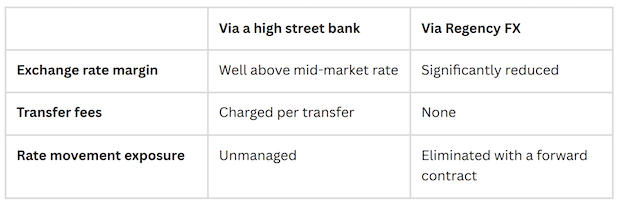
For a buyer purchasing a French property, here is a realistic comparison of the currency costs involved:
Cle France Regency FX Partnership Blog

The saving on a transaction of this size, when working with a specialist rather than a bank, is routinely measured in thousands of pounds. The difference in exchange rate margin alone can be significant and it compounds across every payment made during the transaction.

The Role of a Dedicated Account Manager

What distinguishes a specialist currency provider from a bank or online transfer service is not simply the rate. It is the human expertise and coordination that comes with it.

At Regency FX, every client is assigned a dedicated account manager at no additional cost.

That person:

* Provides a clear, honest assessment of current rates and available options

* Advises on whether to lock in a rate or monitor the market for a better entry point

* Tracks GBP/EUR movements and provides timely updates

* Coordinates transfers around notary deadlines to ensure funds clear on time

When a French property transaction involves strict legal timelines and significant sums of money, this kind of dedicated support makes a material difference. Estate agents, notaries and lawyers are each focused on their own part of the process. Having a currency specialist focused exclusively on yours means nothing falls through the gaps.

Frequently Asked Questions

What are all the costs involved in buying a property in France? Beyond the purchase price, budget for notary fees which vary depending on whether the property is old or new, plus any survey, legal or agent fees. Everything is payable in euros so your total currency requirement is considerably higher than the headline price alone.

When is the right time to think about currency exchange? As early as possible, ideally before you begin your search in earnest. Having a clear picture of how your funds translate into euros helps you set a realistic budget and gives you time to explore rate protection tools before the pressure of a deadline arrives.

What is a forward contract and how does it protect me? It lets you lock in today's exchange rate for a payment you will make in the future. You secure it with a deposit on the amount you want to convert. For a French property purchase, that means the sterling cost you agree today stays the same even if the rate shifts before you complete.

Can buyers purchase property in France without any restrictions? Yes, there are no restrictions. Whether you are buying a permanent home, a holiday property or an investment, the process is the same. A notary oversees the transaction and the two key stages are the compromis de vente and the final acte de vente.

How does Cle France work with Regency FX? Cle France has partnered with Regency FX to give buyers access to specialist currency support as part of their search. If you would like an introduction, just mention it when you enquire and we will connect you directly.

A Final Word

The currency element of a French property purchase is not a minor administrative detail. Buyers who address it early and work with a specialist who understands the French property process consistently achieve better outcomes than those who leave it to their bank or deal with it at the last minute.

Regency FX offer a free, no-obligation quote at any stage of your property search. Whether you are beginning to explore the market or approaching a completion date, it costs nothing to find out how much more of your money you could retain.

To get your free quote, contact Regency FX directly here.

This article has been produced in partnership with Regency FX, specialists in currency exchange for international property transactions. Cle France is the French Property Network, connecting buyers with properties, professionals and resources across France

For everything you need to know about French property visit www.clefrance.co.uk

Add CommentViews: 165
Apr 3

How do the French celebrate Easter?

Actually it is not that different to Easter celebrations in other mainly Christian countries, the French however as you would expect also have their own individual Easter traditions. Perhaps it may come as no surprise that given France's obvious culinary talents, many of the Easter traditions include and involve food.

Easter is an important holiday in France and there are lots of traditions that go with Easter so be sure to wish all your friends and colleagues an enthusiastic 'Joyeuses Pâques' (Happy Easter) !

Easter Hen

Easter Weekend:

Good Friday is typically not recognised as a Bank Holiday in France and it is business as normal. Easter does however consist of a long weekend, and in some sectors, a week or two of holidays but generally it is only the Easter Monday that stands out as different to the normal run of things because every Sunday is still a rest day in France where most large shops and business are closed, unlike the UK these days. In addition to having the chance for a holiday, the French also take the opportunities of Easter to include visiting family and friends, and relaxing.

French Easter Morning:

French children have Easter egg hunts on Easter sunday morning. Eggs are usually chocolate ones and not hard-boiled ones, although the French also play games with raw eggs at Easter. A few Easter games exist, such as competitions throwing and catching eggs and seeing who can toss and catch an egg the longest without breaking it. Another game with raw eggs stems from the Catholic tradition in France. In this game, children each take a raw egg and roll them down a hill (simulating the stone rolling from Jesus' tomb). In this symbolic game, the child whose egg travels the farthest without breaking is the winner.

Easter egg hunts are usually for small chocolate eggs. However, French chocolatiers also have a long-standing tradition of creating oversized ornamental chocolate eggs that are given as gifts. These eggs, like most products from French chocolatiers and patissiers, often look too beautiful to eat!

French boulangerie

How Do the French Celebrate Easter with Food:

In addition to the sweets, French families often make very special meals on Easter Sunday. As with all special French meals, it will usually consist of several courses, be accompanied by wine, and finish with a cheese plate and a delicious dessert.

French Easter Menus:

There is a French Easter tradition of serving lamb as the main course on Easter Sunday. While this is not necessarily always the case, many families still observe this tradition by making a rack of lamb braised with an herb rub or sauce. Other main courses would typically be meat, for example a ham or other choice cuts of meat. Turkey, which is very typical of Christmas, would not often be chosen as an Easter main course.

Preceding the main course, a lighter dish is usually served. This may be something like a quiche or perhaps a salad. Though soup is possible, a cold first course is more typical of a traditional Easter menu. Some families may eat both a salad and another first course.

Following the main course, expect a short break in which everyone remains seated at the table drinking wine. This break is usually followed with a traditional cheese plate with baguette. If you are making a French-style Easter dinner outside France, you'll have to rely on a local supermarket for some French cheeses (get a variety: one bleu, one camembert or brie, one harder cheese, and a goat's cheese if you can find it). In France, expect a few popular French cheeses, as well as a few local ones that you may never have seen or heard of before.

Lastly, Easter dinners are topped off with dessert. Very often, the dessert will include some chocolate, but may not be exclusively chocolate, such as a chocolate berry tart or an almond cake drizzled with a chocolate sauce. If you are in France, expect to spend a long time over Easter dinner, it is meant to be enjoyed slowly.

Blog submitted by: Alex at The French Property Network - Cle France.

Add CommentViews: 54889
Mar 4

Cle France Clients Deserve the Best Possible Service

Introducing our Best Rate Promise

At Cle France, we are always looking for ways to add value to our clients’ experience. That’s why we use and recommend Regency FX.

Regency FX are trusted specialists in international currency transfers, particularly within the overseas property sector.

Their expertise ensures our clients benefit from:

- Personal account management, yes you actually speak to a real person
- Same-day transfers
- Expert market insight and currency guidance
- A Best Rate Promise - meaning they will not be beaten on exchange rates

With currency markets constantly moving, securing the right rate can make a significant difference to you.

Regency FX helps you plan ahead and transfer funds efficiently and securely.

Click below to get in contact today:

Regency FX Website

    • As a Clé France website visitor, you qualify for preferential exchange rates when you transact through Regency FX.

Cle France Currency Guide link

Sharon Evans - Founder of Cle France.

For everything you need to know about French property visit www.clefrance.co.uk

Add CommentViews: 135
Feb 17

UK Pancake Day celebrations and yummy recipe

On Shrove Tuesday across the UK there will be people practising their pancake tossing !

Pancake Day, or Shrove Tuesday as it is more formally known, is a much loved day in the calendar as it a day to indulge yourself by eating delicious pancakes!

Of course even if you are in France on a viewing trip with one or more of the Cle France agents there is no need to miss out on your pancakes, in fact everyday is like pancake day at a French market where they is nearly always a Crepe stand serving freshly made French crepes, so another reason to buy a house in France! See how the French celebrate here.

So how did Shrove Tuesday start? Well the word ‘Shrove' comes from the old English word ‘shrive' which means to confess ones sins. The tradition of Shrove Tuesday began when Christians had to clear out their pantry before Ash Wednesday which marks the start of Lent. Today many people give up just one thing for Lent, however hundreds of years ago all meats, eggs, milk and other rich foods were given up for 40 days to remember when Jesus went into the desert and fasted  for 40 days and 40 nights. The idea was that instead of throwing out the fats and eggs; they should be used to make pancakes as a final feast before the fasting period began.

As well as Shrove Tuesday being a day for making pancakes we must not forget it is also a day for pancake races. This tradition is thought to have began in Olney, Buckinghamshire in 1445 when a woman was making pancakes and she forgot the time. Then suddenly she heard the church bells ring to signal the start of the service and in her panic she ran out of the house and to the church still holding the frying pan with the pancake inside. Pancake races are held in villages and towns across the country, usually with several different races so that all ages can take part. The race usually requires the competitors to run a course while tossing a pancake in their frying pan; the winner is the person who crosses the line first after tossing the pancake a certain number of times.

Cle France Blogs

Our Pancakes above may be a little fancy but all Pancakes are delicious, when cooked right. If you have not tried before or struggle to make perfect pancakes, why not follow this simple recipe by Delia Smith.

Traditional Lemon & Sugar Pancake Recipe 

Makes: 12-14 pancakes

Preparation time: 30 mins

Frying pan: Good heavy one not more than 7 inches / 18 cm in diameter (inside base)

Ingredients

For the pancake mixture:
110g/4oz plain flour, sifted
pinch of salt
2 large eggs
200ml/7fl oz milk mixed with 75ml/3fl oz water
50g/2oz butter
To serve:
caster sugar
lemon juice
lemon wedges

Method

Sift the flour and salt into a large mixing bowl with a sieve held high above the bowl so the flour gets a airing. Now make a well in the centre of the flour and break the eggs into it. Then begin whisking the eggs - any sort of whisk or even a fork will do - incorporating any bits of flour from around the edge of the bowl as you do so.

Next gradually add small quantities of the milk and water mixture, still whisking (don't worry about any lumps as they will eventually disappear as you whisk). When all the liquid has been added, use a rubber spatula to scrape any elusive bits of flour from around the edge into the centre, then whisk once more until the batter is smooth, with the consistency of thin cream. Now melt the 50g/2oz of butter in a pan. Spoon 2 tbsp of it into the batter and whisk it in, then pour the rest into a bowl and use it to lubricate the pan, using a wodge of kitchen paper to smear it round before you make each pancake. 

Now get the pan really hot, then turn the heat down to medium and, to start with, do a test pancake to see if you're using the correct amount of batter. I find 2 tbsp is about right for an 18cm/7in pan. It's also helpful if you spoon the batter into a ladle so it can be poured into the hot pan in one go. As soon as the batter hits the hot pan, tip it around from side to side to get the base evenly coated with batter. It should take only half a minute or so to cook; you can lift the edge with a palette knife to see if it's tinged gold as it should be. Flip the pancake over with a pan slice or palette knife - the other side will need a few seconds only - then simply slide it out of the pan onto a plate.

Stack the pancakes as you make them between sheets of greaseproof paper on a plate fitted over simmering water, to keep them warm while you make the rest.

To serve, sprinkle each pancake with freshly squeezed lemon juice and caster sugar, fold in half, then in half again to form triangles, or else simply roll them up. Serve sprinkled with a little more sugar and lemon juice and extra sections of lemon.

Recipe Source: Delia Smith - Complete Cookery Course Book

Blog submitted by: Alex at Cle France.

Cle France Logo

For everything you need to know about French property visit www.clefrance.co.uk

Add CommentViews: 14071
Feb 13

Celebrating St Valentines Day the French Way

Valentine's Day in France.

The origins of Saint Valentine’s Day are unclear. Ancient Rome celebrated the 14th February as a day of worship to the god Juno, and there are three different Saint Valentines in the Catholic Church. Tradition states that people began to notice that birds began their mating rituals half way through the second month of the year and so the 14th was designated as a day for exchanging love letters and tokens of esteem.

As you would expect from a country whose capital city is so strongly associated with romance, Valentine’s day has throughout history played a part in the love lives of the French. A former Valentine’s Day custom, which was officially banned, was that of ‘la loterie d’amour’, translated as ‘lottery of love’. Single people, both young and old, would go into their houses, (the houses all facing in on each other during this period), and call out until they were paired off with each other. However, if the gentleman was displeased with his ‘prize’ he would simply abandon her, hoping for better luck next time! Those women abandoned by their suitors would build a large bonfire and burn images of their men, cursing and abusing them as the flames burnt. However, due to fears of public disorder the government issued a decree banning the practice.

The origins of the first Valentine cards to be sent also have a French connection: the first known ‘carte d'amitié’, was believed to have been sent in 1415 by the Duke of Orleans who was imprisoned in the Tower of London following the Battle of Agincourt, to his wife.

The village of Saint Valentin, situated in the central department of Indre was traditionally a place of pilgrimage. Nowadays the village holds a number of fêtes to celebrate its association with this patron saint, where people can renew their marriage vows.

Today St Valentine's Day is celebrated in France in much the same way as in the UK where it is an opportunity to exchange cards, flowers, chocolates and other gifts. It has a similar commercial feel also as retailers will stock up on these traditional gifts and cards, and hearts and roses will be the order of the day in shop windows and displays.

Cle France Blogs

Blog submitted by: Alex at Cle France.

Add CommentViews: 15052

Follow Us for the Latest Info

Cle France You Tube Cle France Instagram Cle France Blue Sky Social Cle France Facebook

Quick Search

Minimum Beds/Baths

Price Range

Land in sq metres (1 acre = 4000M2)

Join the Mailing List

Select subscriber list :

Featured Properties

Property of the Week

Property of the Week
 
Stone Houses, Outbuildings, Pond in the Countryside

Lovely Countryside Location

AMR00127 - Dordogne

Priced at 635,000 FAI